Instability of sustainability: green agenda ignores science and technology
Filed under: Archive, Legislation, New Energy Economy, renewable energy
Could this happen in Colorado? Maybe…
A Wall Street Journal article reports what some in Colorado’s energy industry know, too much reliance on wind and solar can make an electric grid unstable and lead to power outages.
California regulators and energy companies met last week out of fear that the state’s electric grid is so unstable due to heavy dependence on wind and solar that rolling blackouts will begin as early as 2015. The WSJ reports:
Regulators and energy companies met Tuesday, hoping to hash out a solution to the peculiar stresses placed on the state’s network by sharp increases in wind and solar energy. Power production from renewable sources fluctuates wildly, depending on wind speeds and weather.
California has encouraged growth in solar and wind power to help reduce greenhouse-gas emissions. At the same time, the state is running low on conventional plants, such as those fueled by natural gas, that can adjust their output to keep the electric system stable. The amount of electricity being put on the grid must precisely match the amount being consumed or voltages sag, which could result in rolling blackouts.
At Tuesday’s meeting, experts cautioned that the state could begin seeing problems with reliability as soon as 2015.
California, which has a 33 percent renewable mandate, has plenty of power but…
Even though California has a lot of plants, it doesn’t have the right mix: Many of the solar and wind sources added in recent years have actually made the system more fragile, because they provide power intermittently.
This story should serve as a warning to all, such as Rep. Max Tyler (D-Lakewood) and former Governor Bill Ritter, who think that government mandating electricity generated from wind and solar is as simple as passing legislation while ignoring science and technology.
In a March 2010 press release Tyler bragged about his bill increasing Colorado’s renewable mandate to 30 percent:
The sun will always shine for free, the winds will always blow for free, and our energy production will be cleaner. Renewable energy, green jobs, and a cleaner future — what’s not to like?
What’s not to like? How about an unstable grid that leads to blackouts. Get your generators now.
Country can breathe sigh of relief. We’re still stuck with him…
By William Yeatman and Amy Oliver Cooke
As Coloradans we thought we might have to apologize to the rest of the country if President Barack Obama nominated former one-term Colorado Governor Bill Ritter to head the Energy Department. If the President wanted to make electricity costs skyrocket and the eco-left community happy, Ritter was his guy, but the President didn’t pick him.
Today, the Denver Post’s Allison Sherry broke the news that MIT physicist Ernest Moniz got the nod and the environmental community is none too pleased according to Mother Nature Network:
Despite his dense résumé and desire to cut emissions, however, Moniz can be a polarizing figure in scientific and environmental circles. Few experts deny the value of a scientist as DOE chief, but many fans of renewable energy worry about Moniz’s gusto for natural gas and nuclear power — not to mention his financial ties to the energy industry.
‘We’re concerned that, as energy secretary, Ernest Moniz may take a politically expedient view of harmful fracking and divert resources from solar, geothermal and other renewable energy sources vital to avoiding climate disaster,’ Bill Snape of the Center for Biological Diversity said in a recent press release. ‘We’re also concerned that Moniz would be in a position to delay research into the dangers fracking poses to our air, water and climate.’
And the Washington Post reports:
But over the past couple of weeks, many environmentalists and some prominent renewable energy experts have tried to block the nomination of Moniz because of an MIT report supporting “fracking” — as hydraulic fracturing is commonly known — and because major oil and gas companies, including BP, Shell, ENI and Saudi Aramco, provided as much as $25 million each to the MIT Energy Initiative. Other research money came from a foundation bankrolled by shale gas giant Chesapeake Energy.
‘We would stress to Mr. Moniz that an ‘all of the above’ energy policy only means ‘more of the same,’ and we urge him to leave dangerous nuclear energy and toxic fracking behind while focusing on safe, clean energy sources like wind and solar,’ Sierra Club executive director Michael Brune said in a statement Monday.
The Sierra Club doesn’t have much credibility because financially it was sleeping with the enemy, having taken $26 million from Chesapeake Energy to destroy the market for coal. One place they enjoyed great success was in Colorado with HB 1365, the fuel switching bill and cornerstone of Ritter’s “New Energy Economy.”
Governor Ritter coined the term New Energy Economy for his signature agenda. In practice, his New Energy Economy entails three policies: (1) a Soviet-style green energy production quota; (2) subsidies for green energy producers; and (3) a mandate for fuel switching from coal to natural gas. Renewable energy is more expensive than conventional energy, and natural gas is twice as expensive as coal in Colorado, so these policies inherently inflated the cost of electricity.
Last month, the Independence Institute published the first ever line item expensing of Ritter’s energy policies, and the results were shocking. In 2012, the New Energy Economy cost Xcel Energy (the state’s largest investor-owned utility) ratepayers $484 million, or 18 percent of retail electricity sales.
This princely sum purchased the equivalent of 402 megawatts of reliable capacity generation. By comparison, Xcel had a surplus generating capacity (beyond its reserve margin) in 2012 of 700 megawatts—almost 75 percent more than the New Energy Economy contribution. Thanks to Governor Ritter’s energy policies, Xcel ratepayers in Colorado last year paid almost half a billion dollars for energy they didn’t need.
In addition to implementing expensive energy policies, Governor Ritter also has experience picking losers in the energy industry. In May 2009, Governor Ritter hand-delivered to Secretary Chu a letter in support of a $300 million loan guarantee for Colorado-based Abound Solar, a thin-filmed solar panel manufacturer. In the letter Ritter claimed Abound would “triple production capacity within 12 months, develop a second manufacturing facility within 18 months and hire an additional 1,000 employees.”
Taxpayer money couldn’t keep Abound afloat, which never reached production capacity. After its solar panels suffered repeated failures, including catching fire, Abound declared bankruptcy in early 2012 leaving taxpayers on the hook for nearly $70 million and even more at the state and local level. A former employee explained, “our solar modules worked so long as you didn’t put them in the sun.”
Abound Solar wasn’t the only pound-foolish Stimulus spending associated with Governor Ritter. During his administration, the Colorado Energy Office’s coffers swelled with almost $33 million in stimulus subsidies for weatherization efforts. According to a recent report by the Colorado Office of State Audits, the Ritter administration failed to even maintain an annual budget for the program. As a result, the audit was unable to demonstrate whether the money had been spent in a cost effective manor. All told, the auditor found that the energy agency could not properly account for almost $127 million in spending during the Ritter administration.
Ritter told the Fort Collins Coloradoan that the scathing audit accusing the agency under his watch of shoddy management practices was not the reason the President passed over him for Energy Secretary.
The former Governor is especially proud of the job creation associated with the New Energy Economy. To be sure, throwing taxpayer money at any industry would create jobs. The problem occurs when the public money spigot runs dry. In this context, an October 22, 2012 top fold, front page headline in the Denver Post is illuminating: “New energy” loses power; A series of setbacks cost over 1,000 jobs and threatens the state’s status in the industry. To put it another way, in the two years since Ritter left office, his New Energy Economy has atrophied in lockstep with the reduction in public funding.
Ritter has taken to proselytizing for the gospel of expensive energy. He founded the Center for the New Energy Economy, the purpose of which is to, “provide policy makers, governors, planners and other decision makers with a road map that will accelerate the nationwide development of a New Energy Economy.” He even brought with him the former head of the beleaguered energy office Tom Plant to work for him as a “policy advisor.”
So far Ritter’s bad energy policy has remained largely within the Centennial State, and, for now, that’s where it will stay. With the choice of Moniz, the rest of the country can breathe a sigh of relief. For Coloradans, we’re still stuck with him.
William Yeatman is the Assistant Director of the Center for Energy and Environment at the Competitive Enterprise Institute and a policy analyst for the Independence Institute in Denver, Colorado. Amy Oliver Cooke is the Director of the Energy Policy Center for the Independence Institute
Natural gas double price of coal in Colorado
According to the most recent Form 10-K that Xcel Energy, Colorado’s largest investor owned utility (IOU), filed with the Security and Exchange Commission dated December 31, 2011, electricity generation from natural gas was more than double the price of electricity generated from coal in Colorado.
A table on page 18 of the report shows that in 2011, Xcel produced 76 percent of its electricity from coal at a cost of $1.77 per MMBtu while natural gas cost $4.98 per MMBtu while providing 24 percent of Xcel’s electricity.
As more and more of Xcel’s electricity is mandated to come from natural gas thanks to HB 1365, the fuel switching bill and the cornerstone of what former Governor Bill Ritter coined the “new energy economy,” along with additional regulations and out right bans on hydraulic fracturing, Xcel ratepayers should get used to spending more and more on their electricity bills.
Baker out at PUC
Public Utilities Commissioner Matt Baker is leaving the PUC to join the William and Flora Hewlett Foundation, a left-leaning non-profit, as “an officer in its Environment Program” foundation officials announced yesterday. Former Governor Bill Ritter appointed the environmental activist Baker in 2008, and his term had expired without current Governor John Hickenlooper acting to reappoint Baker to another term.
Baker was instrumental in steering the state’s “new energy economy” as both an activist and a PUC commissioner. In January the Energy Policy Center raised questions about Baker’s ability to serve as an independent regulator:
Conventional wisdom in energy policy circles says that Governor John Hickenlooper will re-appoint current Public Utilities Commissioner Matt Baker to another four-year term on the PUC. His State Senate confirmation will be a mere formality, but it shouldn’t be.
Serious questions linger about his lack of honesty regarding energy costs and his ability to be an independent regulator.
Rather than regulate Colorado’s investor-owned utilities, the environmental activist-turned-regulator Baker is more interested in advancing his green energy agenda to the detriment of Colorado ratepayers. He and former PUC Chairman Ron Binz (whose own re-appointment was derailed with an ethics violation after which he withdrew his name for consideration) were instrumental in negotiating the language of HB 1365, a senseless fuel-switching bill and the “crown jewel” of Bill Ritter’s New Energy Economy that will cost ratepayers more than $1 billion.
This is blow to the environmental left and Xcel Energy because Baker provided them a seemingly credible voice to perpetuate the myth that Colorado’s 30 percent renewable energy mandate costs electricity ratepayers a mere two percent on their Xcel Energy bills. As we have demonstrated before and reiterated in January this is simply untrue, and Baker and Xcel both know it.
Baker’s love affair with renewable energy prevents him from being objective about Colorado energy policy and thus not honest with the people he is charged with serving – eroding consumer rights and driving up energy costs with regulatory sleight of hand.
In a recent op-ed in RenewablesBiz.com, Baker gushes over the advancement of his green agenda. He repeats one the biggest renewable falsehoods green activists have perpetuated on Colorado ratepayers: Colorado’s largest utility Xcel Energy can acquire 30 percent of its power from expensive renewable sources while keeping a cap on electric rates.
Most ratepayers believe that means that the renewable energy mandate – energy from sources such as wind and solar – will only cost them an additional two percent on their electric bill. “While Colorado’s largest utility, Xcel Energy, has exceeded its goals, it has stayed within the 2 percent cap set by the legislature,” says Baker.
It is true Xcel stayed within the two percent rate cap line item labeled the Renewable Electric Standard Adjustment (RESA) on customers’ electric bills. But it is not true that the RESA represents the real, total cost of renewable energy to Xcel ratepayers, and Bakers knows it.
We were also the first to expose that Baker and fellow commissioner Ron Binz spent a lot of time traveling, which led to ethics complaints being filed against both men. Binz left the PUC rather than seek a second term. In December the ethics commission found that Binz violated the state constitution by accepting a trip paid for by a company he was supposed to regulate. The same commission recently decided there was not “sufficient evidence” to prove that Baker’s trip to Seville, Spain, paid for a spanish government owned company, violated Colorado’s ethics law.
What remains to be seen is who Governor Hickenlooper will appoint to replace Baker. If the Governor’s first appointee, Chairman Josh Epel, is any indication of how he envisions the role of the PUC, ratepayers can expect more balanced treatment in the future.
Cozy relationship between Xcel and PUC?
In a surprising move to anyone who has watched the cozy relationship develop between Xcel Energy and the Public Utilities Commission, yesterday the PUC denied Xcel’s $142 million interim rate request.
Colorado News Agency columnist Peter Blake (then with Face the State) initially exposed how the PUC, Xcel, and Governor Ritter’s administration colluded on the cost recovery language of HB 1365, the infamous fuel switching bill, which allows for Xcel to ask for an interim rate increase without a public hearing. Emails from then PUC Chairman Ron Binz shows just how deeply involved the PUC was with Xcel, the very company the PUC is suppose to regulate:
- March 8, 2010: “We will agree to using the extraordinary cost recovery in proportion to pressure that the approved plan puts on the company’s financial health.”
- March 9, 2010: “The Commission and Xcel have agreed on language for cost recovery.”
- March 11, 2010: “I was working with Karen Hyde up until 9:00 last evening to hammer out the final language in a couple of areas.”
Karen Hyde is Xcel’s vice president for rates and regulatory affairs for Colorado. After yesterday’s decision, she told the Denver Post, “we are very disappointed. We outlined what the negative impact would be as of Jan. 1. We are sorry the commission didn’t recognize the adverse impact of the delay.”
Based on the emails above, Xcel is probably more than “disappointed.” It’s a little like being kicked in the stomach by your new best friend. But since the heady days of the HB 1365 love fest, Ron Binz has left the commission under the cloud of an ethics investigation, which found him guilty of violating the constitution for accepting a privately paid trip without legitimate state purpose from an industry that he was charged with regulating and actually benefitted from HB 1365.
Yesterday’s decision doesn’t mean ratepayers are off the hook. It just means a reprieve until full public hearings are conducted. If the PUC eventually grants the full rate increase, more than a third of which is due to Xcel’s poor management, then we’ll know the PUC and Xcel still are best friends.
Finally some outrage over the New Energy Economy
I may have underestimated the outrage over two recent Xcel Energy rate increase requests.
The first, an attempt to recover the final $16.5 million in cost for Boulder’s Smart Grid City program. Ratepayers are not thrilled about paying for a Boulder project with massive cost overruns.
Check out these comments:
From Phil Carson, editor of the online energy resource Intelligent Utility:
Investor-owned utilities will do whatever they can to pass costs along to the ratepayer, no matter whether those costs are the result of bad decisions, cost overruns or faulty execution. And public utility commissions merely aid and abet this abuse of customers of regulated monopolies by rubber stamping this outrage.
A strong statement, perhaps? I wouldn’t rush to reject it. For one thing, it isn’t mine. It is the precise upshot of statements by dozens and dozens of ratepayers in Colorado in general and Boulder in particular over Xcel Energy’s attempt to recoup another $16.6 million on its SmartGridCity outlays, after succeeding in recovering $27.9 million earlier this year.
Email comments to the Public Utilities Commissions (thanks to Phil for providing the link) share that sentiment:
Mr. William Newell
As I recall the residents of Boulder wanted the smart grid. There was discussion about who would pay for this in 08. Now Excel wants all of the state consumers to pay for Boulders [sic] desire. Boulder Excel [sic] customers alone should pay for the cost of the smart grid. Our rates have already increased much higher than the inflation rate due to government regulations.
Gladys Rey Mendez
Subject: Cash Cow=Customer
When will utilities, both private and public, and their respective regulators, take responsibility for the cost over-runs of projects undertaken…Now the utility want to rate-base the balance of the cost of an experiment and collect from customers who have no association with the experiment. At the end of the day customer costs do not go down. Any real energy saving or efficiencies which dilute revenues and returns, the utilities are right back before regulators proposing rate increases….
Ms. Mendez is onto something. If ratepayers become conscientious energy consumers and use less electricity, then why does the utility come before the PUC looking for another rate increase?
Take Xcel Energy’s requested $142 million rate increase. Nearly 37 percent of that rate increase, $53 million, is to pay for excess capacity that Xcel no longer sells wholesale to Black Hills Energy, resulting in increased costs for both utilities that they pass along to ratepayers. The Denver Post’s Mark Jaffe explains:
In 2004, Xcel, with 1.3 million Colorado customers, told Black Hills it would not extend the contract and would use the 300 megawatts of generation for its own service area.
Black Hills, which serves 93,300 electric customers in southeastern Colorado, built two gas-fired power plants in Pueblo to fill the gap and got a $23 million rate hike — which takes effect Jan. 1 — from the PUC to recoup the costs.
But it turns out Xcel has excess generating capacity and doesn’t need the 300 megawatts at this time.
As part of its $142 million rate request, Xcel is asking for $53 million to cover the carrying costs of the excess capacity.
Jaffe also quotes Xcel’s Karen Hyde who blames the recession for “damped demand.” But I suspect that some of Xcel’s own policies also “damped demand.”
How about tiered rates? How about Xcel Energy’s own conservation program Responsible By Nature, which enjoys a massive marketing campaign, that encourages decreased electric usage and provides information about rebates for energy saving appliances (for which ratepayers also pay)?
Isn’t less energy usage exactly what everyone — the PUC, Xcel Energy, the environmentalists — wanted? Now they get it, and ratepayers are punished.
Customers, including businesses and consumer advocacy groups, are lining up in opposition to the latest rate increase. The money quote comes from Wal-Mart Stores, Inc., which also submitted comments against Xcel’s rate increase.
An affidavit from Steve Chriss, the Senior Manager of Energy Regulatory Analysis for the Bentonville, Arkansas based corporation questioned why the PUC would grant a $100 million plus rate increase without thorough public vetting process.
Chriss also addresses the gigantic electric elephant in the living room. Why is Xcel “guaranteed” a 10.5 percent rate of return:
6. PSCo claims that the interim rate relief is necessary because in 2010 that Company earned “only” a 10.23 percent return on equity during 2010, which is below their current authorized return on equity of 10.5 percent.
7. To the extent that PSCo claims that its financial circumstances are exigent the Commission should consider that according to the Edison Electric Institute, the average return on equity awarded in 2010 by utility regulatory commission was 10.29 and for the first three quarters of 2011, the average return on equity awarded was 10.24….
8. Additionally, the Commission should consider that ratemaking principles do not guarantee the Company’s approved rate of return. Instead, rates are set in such a way that the Company has the opportunity, but not a guarantee, to earn their approved rate of return.
HB 1365 allows for it. Colo. Rev. Stat. § 40-3.2-207 (3) reads:
Current recovery shall be allowed on construction work in progress at the utility’s weighted average cost of capital, including its most recently authorized rate of return on equity, for expenditures on projects associated with the plan during the construction, startup, and preservice implementation phases of the projects.
As William Yeatman and I pointed out in our paper exposing the collusion between Xcel, the PUC, and former Governor Bill Ritter’s office, the current rate of return is 10.5 percent. Anything to do with implementing it (and that’s pretty much everything) is subject to the same rate of return.
The PUC may give lip service to caring about ratepayers, but the commissioners, Gov. Ritter, and a majority of state legislators, made a deal with the devil. As we wrote in October 2010:
As mentioned earlier, the Ritter administration led negotiations for the fuel- switching bill, but the PUC was also a willing participant in brokering a deal to assure Xcel’s cooperation. Peter Blake, writer for the popular Colorado politics blog Face the State, exposed the collusion:
Binz was trading flurries of e-mails on the pending bill with Ritter aide Kelly Nordini, natural gas lawyer Russell Rowe, and Xcel executives Karen Hyde, Roy Palmer and Paula Connelly. Xcel, seeking immediate and complete cost recovery for their capital costs, wanted to be sure the PUC would support that.
Even more damaging revelations come from Binz’s emails from earlier this year:
- March 8: “We will agree to using the extraordinary cost recovery in proportion to pressure that the approved plan puts on the company’s financial health.”
- March 9: “The Commission and Xcel have agreed on language for cost recovery.”
- March 11: “I was working with Karen Hyde up until 9:00 last evening to hammer out the final language in a couple of areas.”
Blake noted the bill “was introduced four days later and rushed through the legislature in a couple of weeks.” Denver Post columnist Vincent Carroll makes the same case for collusion: “As early as last December [2009],” two PUC Commissioners Baker and Binz, “had talked with natural gas interests about possible legislation and have been touting it since.”
Earlier this year, PUC Chairman Ron Binz withdrew his name for consideration of a second four-year term in the wake of an ethics investigation over questionable travel expenditures.
Xcel likely will get what it wants on the Smart Grid project because it already settled with the PUC on cost back in 2009. As for the rate increase, the PUC and the state legislators who have enabled Xcel walk a fine line. Xcel likely will get most of what it wants because it has lobbyists and ratepayers don’t.
While I’m grateful that there is some outrage over these latest rate increases, I can’t help but wonder why now when HB 1365 will cost ratepayers more than a $1 billion, the State Implementation Plan another $100 million, and this year renewable energy mandates add another $100 million plus.
The New Energy Economy is a very expensive economy. It’s about time ratepayers realized it.
An 89.5 percent increase since 2004
Ho hum, Xcel Energy wants another $142 million rate increase, and it wants to recover another $16.5 million for its Boulder smart grid project. And in other news, dog bites man. If the Public Utilities Commission denied the rate increases, that would be a news story.
This is all part of Colorado’s New Energy Economy. Rates continue to go up, but isn’t that a reasonable price to pay to feel good about our windmills and solar panels? Or is it?
When we write about the consequences of the policies that make up Colorado’s New Energy Economy, we discuss them on a macro level. Policies such as renewable energy mandates, fuel switching, carbon taxes, tiered rates, and the state implementation plan will cost Xcel Energy ratepayers more than $1 billion in the years to come. Reports claim that average increases have been roughly 20 percent over the last few years and another 20 percent is predicted for future years.
But what do these policies mean specifically to Colorado’s working families? Let’s take mine for instance…
Pre-New Energy Economy:
To bring the cost of Colorado’s energy policy to the kitchen table, I went digging through my old files and found a pre-New Energy Economy electric bill. A 5,000 square foot home provided enough room for my family of five and a home office. I could work from home and take care of kids. With all the activity, my November 2004 Xcel Energy bill shows that we used 2,848 kilowatt hours for a total cost of $217.59, or 7.6 cents per kilowatt hour.
Post-New Energy Economy:
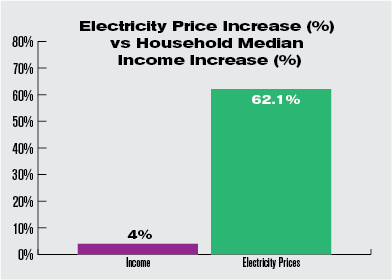
In July 2011, living in a different 5,000 square foot home but still with five people and a home office, we used 2,701 kilowatt hours of electricity at a total cost of $389.15, or 14.4 cents per kilowatt hour. That is an 89.5 percent increase in just seven years thanks, in part, to New Energy Economy policies such as renewable energy mandates, carbon taxes, fuel switching, and tiered rates (especially tiered rates).
Had electric rates simply kept up with the rate of inflation, my $217.59 bill in 2004 would have cost $260.59 in 2011, a mere 19.8 percent increase.
While it’s easy to get angry at Xcel Energy for profiteering off ratepayers through its state-sanctioned monopoly, but that’s like getting mad at a rattle snake for doing what comes naturally — biting you. The people to blame are elected officials and Public Utilities Commissioners who are supposed to be watch dogs for ratepayers but instead indulge special interests and their own green agenda regardless of cost to ratepayers.
Bad news for EU could be bad news for CO
Bad news for residents of the European Union and possibly Colorado. EU consumers and businesses face more than twenty years of rising electric costs as the region tries to meet its renewable energy goals according to a leaked report.
The the working title of the draft report “Energy Roadmap to 2050″ examines how the EU will meet its goal of 80 percent reduction of 1990 levels of greenhouse gas emissions by 2050. It’s due to be released by the end of the year.
According to a recent Financial Times article, the 112-page report examined various scenarios under which the EU could move away from carbon-based electrical generation and toward wind power and other renewable energy sources. Over the next several decades reliance on wind could go from just 5 percent to 49 percent of the EU’s energy portfolio.
As the number of wind farms increases so do energy prices. Under one scenario energy prices may increase 100 percent by 2050.
This report is bad news for Colorado because in 2008 then Governor Bill Ritter issued an executive order to reduce Colorado’s greenhouse gas emissions at least 20 percent 2020 and 80 percent by 2050.
Earlier this year, we exposed that Ritter’s New Energy Economy will cost Xcel Energy ratepayers $212.3 million (8 percent of their Xcel bill) in 2011 for just four pieces of legislation.
Florida’s ‘fuel mix’ a warning to Colorado
Florida has higher electric rates than those of neighboring states because of its reliance on natural gas to generate electric power according to a study released in September.
In a September 27, 2011, press release the Florida Public Service Commission (PSC) said it requested the study from the Public Utility Research Center (PURC) located at the University of Florida’s Warrington College of Business “as part of an initiative to find ways to hold down utility rates.”
Two key findings from the study titled “Addressing the Level of Florida’s Electricity Prices”:
- From 1990 through 2002, Florida’s electricity costs were comparable to the other states’ costs. Beginning in 2003, the residential cost of electricity in Florida grew faster than costs in the other states and is now about 10% higher than the next highest state, Alabama.
- Overall, it appears that Florida’s electricity costs appear high relative to those of neighboring states because Florida uses more natural gas to generate electricity than do the other states.
In 1990, Florida got roughly 60 percent of its electricity from uranium and coal, and is down to 40 percent today. The decline is offset by an increased reliance on natural gas, which by 2009 accounted for 50 percent of the state’s electricity. ”In contrast, the neighboring states of Alabama and Georgia generated 66 percent and 78 percent, respectively, from coal and nuclear energy.”
PSC Chairman Art Graham responded to the study and Florida’s fuel mix:
‘It comes with a cost—Florida’s residential customers pay 10 to 20 percent more than they would in other Southeast states. Documenting the reason for higher prices is an important first step in restraining rates.’ He cautioned that cost is just one factor to consider in fuel diversity decisions, however.
Coloradans would be wise to keep an eye on Florida because with HB 1365, the fuel switching bill, we are headed in the same direction.
Abound Solar’s connections to $400 million
This column appeared originally on Townhall Finance.
Crony capitalism Abound: anatomy of a taxpayer-guaranteed loan
By Amy Oliver Cooke
By now it’s obvious that the Solyndra scandal never should have happened. It’s not even a case of Monday morning quarterbacking. A number of people involved could see the disaster coming.
There is a larger principle here. Government should not use taxpayer money to socialize risk while privatizing profits. Examples such as Colorado-based Abound Solar, which received a $400 million loan guarantee, prove that crony capitalism simply rewards the well connected at taxpayer expense.
Abound Solar
Abound Solar, according to its Web site, “produces next-generation thin-film cadmium telluride solar modules” and “is committed to reducing the cost of solar electricity to levels competitive with fossil fuels.”
It is the brainchild of former Colorado State University (CSU) Professor W.S. Sampath and two former students Kurt Barth and Al Enzenroth. It began as AVA Solar and then incorporated into Abound in 2007.
The Web site says it employs 350 people in three Colorado locations. Its Colorado manufacturing plant is located in Weld County, which granted Abound up to $100,000 per year for the next ten years in business property tax rebates. According to sources, the reason for the rebate was job creation intended to benefit Weld County residents. Yet when officials and interested parties ask how many of the 350 jobs have gone to Weld County residents, the solar company does not answer.
Currently Abound has a manufacturing capacity of 65 megawatts expanding to 850 megawatts – at some point. However, in 2010 it manufactured only 30 megawatts. One wonders, if Abound can produce more, why doesn’t it?
The Web site does say it is “growing,” and news reports claim the company plans to add anywhere from 850 to 1,000 employees thanks to a $400 million taxpayer-guaranteed loan Abound received in July 2010. The taxpayer cash is so it can expand its manufacturing capabilities to a facility in Tipton, Indiana. The Indiana Economic Development Corporation “extended up to $11.85 million in tax credits and $250,000 in training grants” as well.
Abound Solar further claims $260 million in private investments, part of which came from billionaire medical heiress Pat Stryker’s Bohemian Companies. This is where the story gets interesting.
Thanks to Independence Institute investigative reporter Todd Shepherd, we still have access to the Web page that lists Bohemian as an investor even though it does not appear on the company’s current Web site. The exact amount that Stryker has given is not public at this time. Also, CSU and the National Renewable Energy Laboratory (NREL) are listed as funding resources.
Total public and private monies equal $673,100,000. Assuming Abound can “create” some 1,350 jobs, that is $498,593 per job, of which $360,000 comes from public coffers.
However, Abound’s Indiana manufacturing facility is not scheduled to open until 2013 or 2014, which seems like a long time to wait to “create” jobs and turn a profit.
As a comparison, the Denver Bronco’s stadium cost $364 million to build of which 68 percent was publicly financed. With a yes vote from taxpayers in November 1998, construction began in August 1999 and was completed in September 2001.
This is not an endorsement of publicly funded professional sports facilities but rather an assumption that the Broncos management didn’t want a disruption in cash flow that could come from the inconvenience of a lengthy construction project.
I asked Abound if the company is still on track for a 2013 expansion and received no response. For most companies, time means money except in solar panels.
Pat Stryker
Forbes lists medical heiress and founder of Bohemian Companies/Foundation Pat Stryker as number 331 of its top “400 Richest People in America.” Worth $1.3 billion, the Fort Collins resident could single-handedly fund Abound Solar and still be well above the poverty line.
While some of her fortune has gone to Abound Solar, she also has chosen to donate more than $2.2 million (probably a low figure) to Democrats and their causes over the last several election cycles. Beneficiaries include Barack Obama, one-term Congresswoman and Fort Collins resident Betsy Markey, and Interior Secretary Ken Salazar when he successfully ran for U.S. Senate in Colorado.
Stryker is also a charter member of the notorious “gang of four” which changed the political landscape in Colorado through an organization called the Colorado Democracy Alliance (CoDA). Their success was titled the “Colorado Miracle” and is being replicated in other states.
Congresswoman Betsy Markey
With the help from Stryker in 2008, Markey beat incumbent republican Congresswoman Marilyn Musgrave in Colorado’s conservative 4th Congressional District. Abound Solar, Pat Stryker, and Colorado State University are all in the 4th CD. Between 2008 and 2010 election cycles, CSU employees also donated nearly $27,000 to Markey’s campaigns.
When the Waxman-Markey (named for Congressmen Henry Waxman and Ed Markey) cap and trade bill, which included a national renewable energy standard, came up for a vote, Congresswoman Markey danced around the issue for weeks because it wasn’t a popular bill in the 4th CD. Ultimately she voted “yes.”
In an interview on my radio show following the vote, Markey cited “green jobs” as one of her reasons. What she didn’t cite was her relationship to Pat Stryker and Abound Solar or the $2,000 campaign contribution she received from Henry Waxman the night before the vote.
Shortly after the vote, Abound Solar was part of a group that helped pay for TV ads thanking Markey for saying yes to Waxman’s bill. Todd Shepherd exposed the politically incestuous relationship and suggested:
[T]he connections between Representative Betsy Markey (D, CO-4), billionaire heiress Pat Stryker, and Abound Solar, appear to have all of the fingerprints of the kind of pay-to-play agenda that has left many Americans wondering how they got stuck with unpopular bills such as cap and trade, formally known as Waxman-Markey (named after a different Markey).
Markey also urged the approval of Abound’s $400 million taxpayer-guaranteed loan. The Denver Business Journal reported, “Abound applied for the loan guarantee more than a year ago, and Markey and other members of Colorado’s congressional delegation pushed for approval.”
Colorado State University
Located in Fort Collins, Colorado, CSU fancies itself the “green” university:
“Colorado State University is internationally known for its green initiatives and clean-energy research including alternative fuels, clean engines, photovoltaics, “smart” grid technology, wind engineering, water resources, and satellite-based atmospheric monitoring and tracking systems. It’s also known as a “green” university for its sustainability efforts on campus and abroad.
Abound Solar founders got their start at CSU as the university bragged in a 2007 press release.
Stryker also has a connection to CSU, having donated millions to the university. Furthermore, former CSU president Al Yates became Stryker’s mouthpiece and representative on CoDA. The Blueprint, a must-read book from Adam Schrager and Rob Witwer, details the Yates-Stryker relationship along with how democrats won control in Colorado.
Finally, CSU is home to the Center for the New Energy Economy headed by former Colorado Governor Bill Ritter, a renewable energy activist, and funded by private donations, a third of which came from Stryker’s Bohemian Foundation. Ritter now makes $300,000 to promote renewable energy throughout the country.
Governor Bill Ritter
With the help of CoDA and Pat Stryker, Democrat Denver District Attorney Bill Ritter won the 2006 Governor’s race. His one term legacy is the state’s New Energy Economy, 57 pieces of legislation to move the state from reliance on less costly on fossil fuels to renewables. Ritter is a true believer, an eco-evangelical, who signed laws mandating 30 percent renewable energy standards and fuel switching.
In April 2009, Governor Ritter hand-delivered two letters to Energy Secretary Steven Chu who was touring NREL. One letter urged the Department of Energy to grant a $300 million taxpayer-guaranteed loan to Abound Solar:
This request for $300 million would allow [Abound Solar] to triple production capacity within 12 months, develop a second manufacturing facility within 18 months and hire an additional 1,000 employees.
Abound received $400 million in July 2010. By all accounts, the solar panel company will not meet Ritter’s original promise of triple capacity in a year and a new facility within 18 months. Just won’t happen that fast.
When Ritter left office in January 2011, he became the Director of the Center for the New Energy Economy at CSU and one of the highest paid administrators on campus, thanks to Stryker.
President Barack Obama
President Obama received $11,700 directly from Stryker and Joseph Zimlich, who is a director at Abound Solar and is also associated with Stryker’s Bohemian Foundation. No doubt Obama benefitted as well from Stryker’s donations to other democrat causes including Campaign Money Watch and Democrat White House Victory Fund.
In Obama’s weekly radio address on July 3, 2010, he announced an acceleration of “the transition to a clean energy economy and doubling our use of renewable energy sources like wind and solar power – steps that have the potential to create whole new industries and hundreds of thousands of new jobs in America.”
He said that Abound Solar:
will manufacture advanced solar panels at two new plants, creating more than 2,000 construction jobs and 1,500 permanent jobs. A Colorado plant is already underway, and an Indiana plant will be built in what’s now an empty Chrysler factory. When fully operational, these plants will produce millions of state-of-the-art solar panels each year.
That radio address was the formal announcement that Abound Solar received a $400 million loan guarantee courtesy of U.S. taxpayers. Taxpayers get the risk while individuals get the profit.
To recap, Abound Solar receives support from Pat Stryker and Colorado State University both of which fund and promote Congresswoman Betsy Markey. She in turn votes yes on Cap and Trade and urges the federal government to approve the Abound loan.
Abound Solar then contributes to TV ads thanking Markey for her yes vote on Cap and Trade.
Governor Bill Ritter hand delivers letters to Energy Secretary Steven Chu urging the DOE to grant the loan guarantee. When he decides not to run for a second term, he is offered a job at CSU, which is funded in part by Pat Stryker.
President Barack Obama benefitted from Pat Stryker’s political donations. In July 2010, he announces a $400 million loan guarantee to Abound.
Can’t get a $400 million loan? Apparently you don’t know and fund the right people.
Amy Oliver Cooke is the director of the Colorado Transparency Project for the Independence Institute and writes on energy policy. She can be reached at amy@i2i.org